Designing Better Humanitarian Responses
We design emergency replacement windows around the conditions in which they must actually work.
Field evidence, local production and direct feedback guide how each system is tested, improved and delivered.
Why innovation matters
The standard emergency response was not enough
Boarding a damaged window may close the opening, but it removes natural light and offers little protection from cold, damp and severe weather.
The accepted response
A wooden board.
Fast and familiar, but dark, poorly insulating and difficult to live behind for any length of time.
A better first response
Transparent. Insulating. Low-cost.
Insulate Ukraine developed emergency windows to help homes, hospitals, schools and public buildings remain usable after damage.
Our solutions
Two systems shaped by different operating conditions
Both restore natural light and basic weather protection. The main difference is how each system reaches the people who need it.
Team-installed
Emergency Window
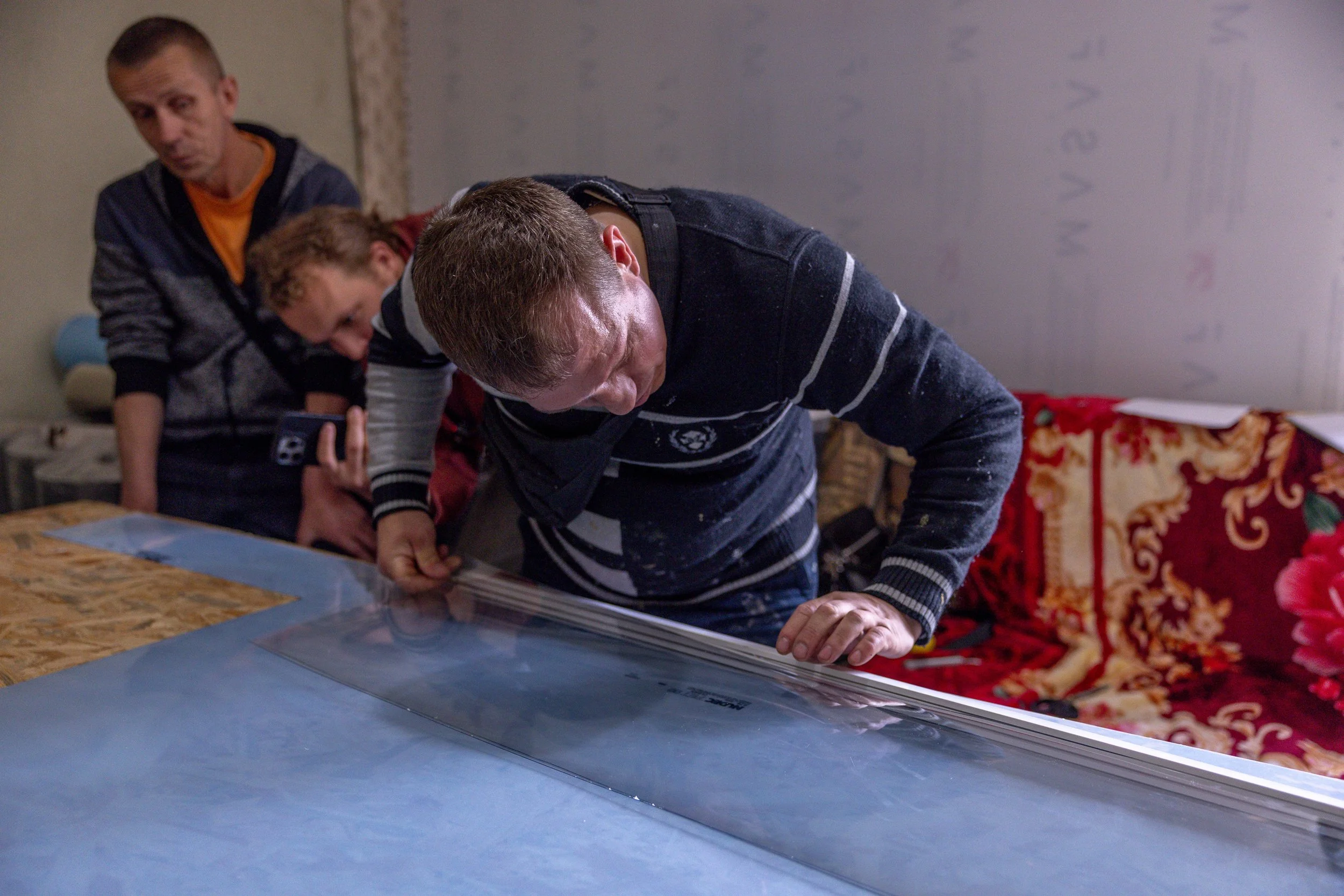
Produced and installed by trained local teams where measurement, production and installation can be coordinated on the ground.
Designed for distribution
WindowKit
Built for individual, partner-led or team installation where direct distribution is the more practical response.
Design and development
How a response earns the right to scale
A useful idea is not enough. It must work in damaged buildings, with available materials and skills, under real delivery conditions.
- 01
Work with locals on the ground
Start by listening to and learning from the people who live and work in the area. Understand damaged buildings, available materials, local skills, supply constraints and real delivery conditions.
- 02
Define the practical requirements
Set requirements for natural light, weather protection, insulation, affordability, production and rapid deployment.
- 03
Build a testable prototype
Turn the requirements into a working design that can be assessed, changed and reproduced. A prototype is a question to test, not a finished claim.
- 04
Trial it in real conditions
Test production, installation and use with the people who will carry out the work. Real trials reveal problems that controlled demonstrations cannot.
- 05
Collect evidence and feedback
Gather evidence from local teams and recipients about performance, sourcing, production, installation and use.
- 06
Revise, branch or scale
Use the evidence to improve an existing version, develop a separate system for another operating reality or expand use.
Questions about our process
How we make development decisions
These answers explain how field evidence becomes a design decision. Detailed product specifications are available on our window pages.
Why maintain two window systems instead of consolidating them?
The systems respond to different operating conditions. The Emergency Window works where trained local teams can measure, produce and install each window. WindowKit can be distributed for individual, partner-led or team installation where direct distribution is the more practical response. Neither approach can serve every context alone.
How do you decide that a design is ready to scale?
A design moves beyond trial use when it meets the practical requirements, can be sourced and produced reliably, and performs in the conditions where it will actually be used, including security risks, disrupted supply chains, limited access, and changing conditions caused by war and other crises. Wider use must also be supported by feedback from local teams and recipients. We assess both the window itself and the wider system needed to produce, deliver, install, and adapt it as conditions change.
What would cause you to revise or retire a design?
We would revise a design if field evidence showed that it no longer met the practical requirements, could not be sourced or delivered reliably or created avoidable difficulties for the people producing, installing or using it. We would retire it if it no longer served a distinct operating need or another response consistently worked better in that context.
Put innovation into practice
Help better-designed aid reach more homes
Support the next emergency window, explore where our teams are working, or partner with us to expand production, distribution and technical collaboration.